
Broomfield Arrest Reports, Not Log
Broomfield publishes no multi-day, 72-hour, weekly, or historical booking blotter. The Active Booking PDF is a snapshot instead. It shows current custody only. There is no booking-date column and no roll-off rule. Archive depth is absent, and so is any multi-day photograph policy. Treating it as a dated table would misstate what the document actually holds. The strongest dated official source is the BPD News Releases archive. Those are selected investigation and arrest announcements. They are not routine booking rows. Community Crime Map adds place and category context. Local news fills editorial gaps. For a complete person-specific record, BPD Records and the court remain the proper paths.
Read Broomfield Arrest Reports
Work backward by publication date. Then check the agency and the court. An article date is rarely the arrest date, and a map event never proves a detention-center booking.
- Search the official BPD News Releases list by date and case wording. Treat each item as a selected agency announcement.
- Check the Community Crime Map for incident context, while accounting for location offset and withheld sensitive categories.
- Search reputable local news archives for additional reporting, attribution, corrections, and follow-up stories.
- Confirm current housing separately through the Broomfield Active Booking report if custody is still at issue.
- Request the arrest or incident record from BPD Records and use the Broomfield County court docket for charges as filed and final disposition.
The official BPD News Releases page leads any multi-day search because it speaks for the investigating agency itself.
The Broomfield news-release channel is dated but selective. It should never be relabeled as a comprehensive arrest log.
Broomfield Arrest Report Details
No single arrest-log schema exists here. Each channel offers different facts. A BPD release may carry a case narrative and agency attribution, while the active custody report holds structured detention fields. News articles can add interviews or context, though editorial judgment shapes what they contain.
| Source | Fields or context to expect |
|---|---|
| BPD News Releases | Publication date, event narrative, BPD attribution, selected arrest information, and a media contact when supplied. |
| Community Crime Map | Incident type, approximate mapped location, and time context, subject to privacy limits and current interface settings. |
| Active Booking report | Name, inmate ID, date of birth, release date, bond amount, statute, and descriptive charge or agency text for current detainees. |
| Local news article | Story publication date, sourced charge, case context, and sometimes an agency or scene image. |
| BPD or court record | Person-specific arrest, report, case, hearing, and disposition information, subject to access rules. |
A publication date is not an arrest date. The report may describe an older investigation. Or a later article may cover a court development rather than a fresh booking. An image credited to BPD in a news story proves nothing about the jail roster. The Active Booking PDF itself displays no booking photo.
Broomfield Arrest Map Context
Broomfield bills its Community Crime Map as a police blotter. The map itself stays incident-oriented. A historical city memo on the predecessor system noted daily automated uploads. It also recorded mid-block location offsets and withheld sensitive calls. Those limits matter. They keep a map from being a complete arrest list. Read the present interface directly. Historical settings may have changed. The Broomfield Community Crime Map information page gives the official context. Map patterns show where events cluster. They cover several days. But names are absent. The map cannot show whether a person was booked, released, transferred, or cleared. The detention report answers current custody, and BPD Records answers person-specific record questions. The court docket continues after booking and carries the filed charges and outcome. That split is why map points must never become a names-based arrest report.
Broomfield Arrest News Is Selective
Regional outlets form a rolling but incomplete stream. Denver7's Broomfield section has reported attempted-homicide, robbery, barricade, and homicide arrests. CBS Colorado covers the city through a tag and statewide crime reporting, while Denver Gazette stories surface through search and local coverage rather than a dedicated Broomfield booking page. Daily Camera covers Broomfield and the north metro. It keeps no arrest roster. Broomfield Enterprise is the local paper, and Westword has published case-specific Broomfield crime stories. A story may carry a scene image, generic law-enforcement art, or a photo from an agency. None keeps a daily booking blotter. Editorial interest drives coverage. Routine arrests may get no story, and major cases draw updates long after the arrest. One Westword Broomfield arrest story shows this case-by-case pattern.
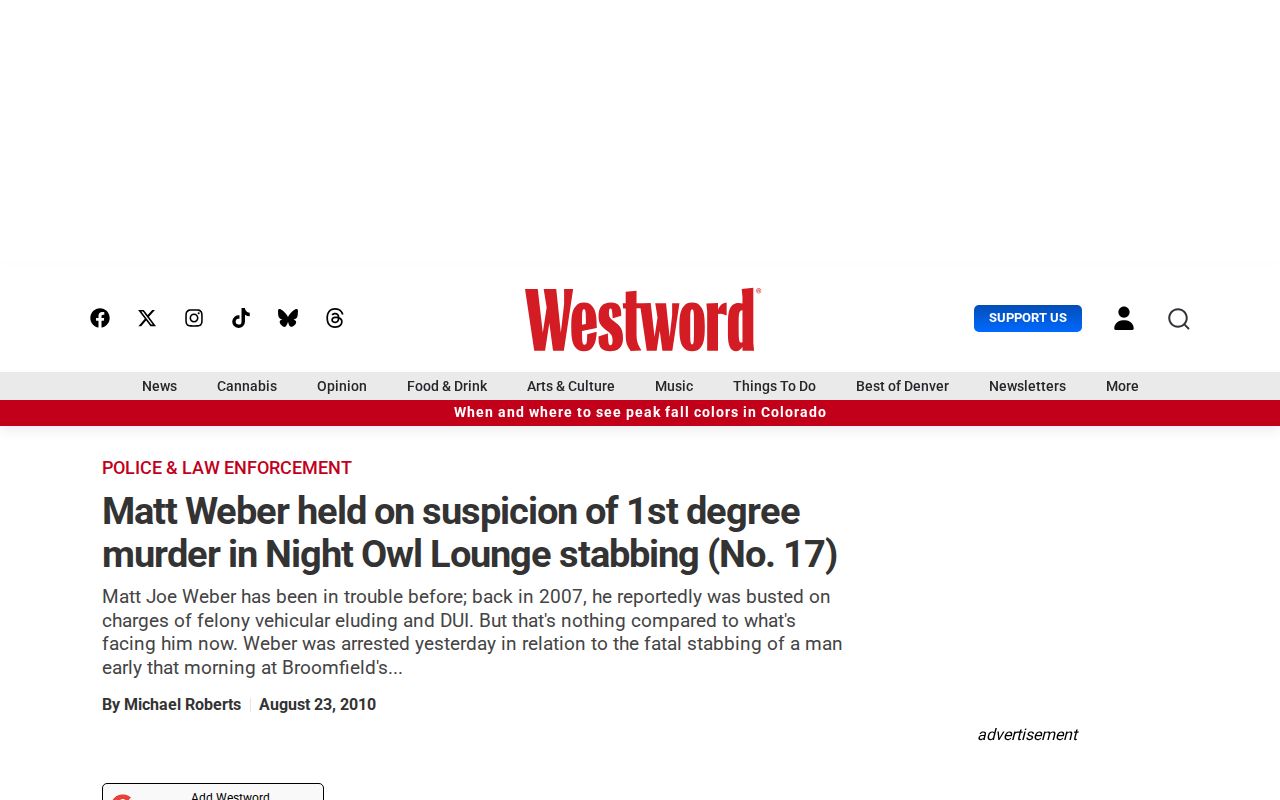
The story is supplemental reporting, not a custody record. The court docket shows how the case later ended.
Broomfield Arrest Trends Need Context
Broomfield's budget paperwork counts detention activity, but it never names anyone. The 2026 budget lists an average daily detention population of 94.83 in 2023. That fell to 72.47 in 2024. For 2025, the year-to-date average sits at 65. Bookings totaled 2,933 and 2,796 in the first two years, with 1,450 more year-to-date in 2025. The totals show scale. That is all they show.
They cannot say who was arrested in Broomfield last weekend, or whether one incident produced several bookings. A booking count is just a door count. Trends belong in one bucket, names in another. Mixing a statistic with a news release from a different time span builds a claim about current arrests that neither source supports.
Broomfield Arrest Report Archives
The BPD News Releases page keeps releases from the past three years. That window is real, but limited. It is a news archive, not a booking archive. For older coverage, the Broomfield Enterprise NewsBank archive covers 2001 to the present.
Newsprint adds color that ledgers lack. Still, a newspaper story is not the booking packet, and it may miss later corrections. Old Broomfield arrest reports raise a second question: how long are they kept? No public retention period covers booking rows, photographs, or full packets. BPD Records holds retention duty. Its public page lists no duration per field or image.
A row vanishing from the live roster means little. The record itself may still sit intact. For a modern record, contact BPD Records at 7 DesCombes Drive, Broomfield, CO 80020. Call 303-438-6420 or write Police-Records@broomfield.org. Ask whether the record lives with BPD, the Detention Center, another agency, or the court. Request the retention schedule too. A city record may call for the JustFOIA public-records route.
Unofficial Broomfield Arrest Sources
Official Broomfield sources come first for a reason. None of the big mugshot aggregators lists a Broomfield County page. RecentlyBooked, Mugshots.com, Arrests.org, Busted Newspaper, and Mugshots.zone all come up empty. A statewide Colorado page proves nothing about local arrests. Watch one old aggregator page that lumps Broomfield with Adams County, because Broomfield has been a consolidated city and county since 2001.
JailExchange and InmateAid keep Detention Center directory pages. Neither runs its own live multi-day booking feed. They can point to the official roster or VINE. Any unofficial result may sit stale, incomplete, or under the wrong jurisdiction. Before trusting an arrest entry, confirm the agency, the custody status, and the court case.
Request Older Broomfield Arrest Records
A good records request is a specific one. Name the person, the agency, and the approximate arrest date. Add any report, inmate, or court number. Say what you want, whether an arrest report, a booking sheet, the booking time, or a releasable photograph. Ask the custodian to explain any redaction or withholding basis and to provide a cost estimate. Broomfield publishes no separate booking-photo fee.
History lives elsewhere. Colorado State Archives holds some Department of Corrections prisoner photographs and negatives. It is not a Detention Center photo archive. A current record may stay with the city, another criminal-justice agency, or the court, or be disposed of under an approved schedule. For a present-tense question, the Arrested Today page maps the current-custody route; for older matters, start with the official custodian and work outward.